
In hydraulic transport, a pump never operates in isolation. Its performance is governed by the dynamic interaction between the pump curve and pipeline characteristics, and one of the most influential components in the relationship is the choice of drive. Surprisingly, however, this factor is still widely misunderstood across the dredging industry.
Selecting the right drive not only improves efficiency. It determines whether the system can operate safely, sustainably and at the required production rate.
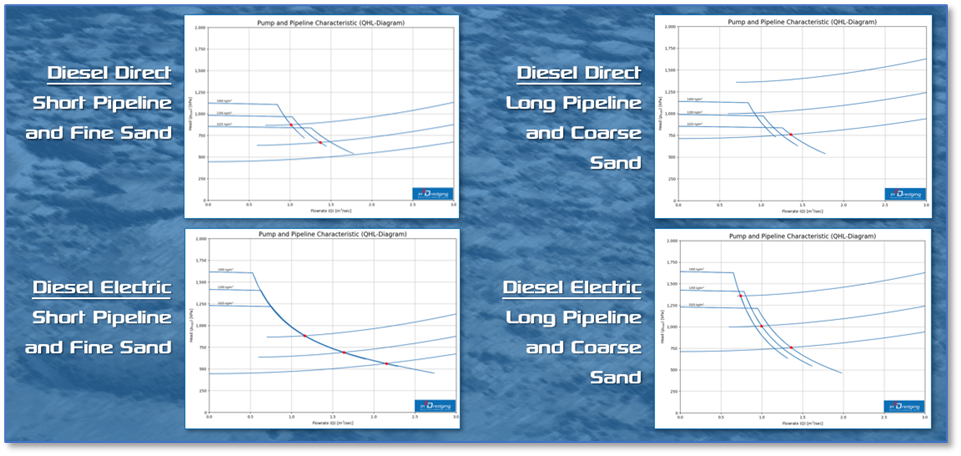
Diesel Drives: Constant Torque and a Narrow Operating Band
A diesel engine typically delivers constant torque across most of its operating range. While that may seem advantages, it severely limits the pump’s flexibility. In practice, this means the pump can only operate effectively between roughly 80 – 100 % of its nominal revolutions.
When the pump is pushed outside this narrow band, the diesel engine reaches its fume limit and torque rapidly collapses. This forces the pump into conditions that are unsafe or inefficient. As a result, diesel-driven pumps often struggle when:
- The pipeline is very short or extremely long;
- Pumping either very fine or very coarse material; or
- Operating conditions fluctuate significantly.
To compensate, operators often resort to workarounds, such as adding orifices, swapping impellers or adjusting gearing. These measures are taken simply to reach an acceptable operating point. However, they are frequently inefficient and increase the risk of mechanical issues.
Diesel Drives: Constant Power and Greater Flexibility
Electrical drives behave fundamentally differently from diesel drives. Rather than constant torque, an electrical drive delivers constant power across a wide range of revolutions. This allows the pump curve to shift significantly, providing a far larger window of viable combinations of head and flow.
Electrical systems can adapt effectively to the following operational changes without forcing the pump into damaging conditions:
- Varying pipeline lengths;
- Fluctuating mixture densities;
- Changing particle sizes; and
- Evolving operational demands.
This flexibility translates directly into more sustainable operations, fewer mechanical failures and supports higher, more stable and predictable production.
When Pumps Become "Unhappy"
If the operating point falls in the wrong region of the pump curve, the pump becomes what operators call “unhappy”. Symptoms include:
- Low efficiency;
- Increased vibration;
- Cavitation;
- Accelerated wear; and
- In worst cases, damage and equipment loss.
Understanding these interactions is essential for anyone involved in the design, operation or troubleshooting of hydraulic transport systems.
Explore
Hydraulic Transport Further in Our Pumps ‘n Pipeline (PnP) Masterclass
For those wanting to deepen their understanding of the fundamentals of pump, pipeline and mixture behaviour, in2Dredging's (i2D) upcoming PnP Masterclass provides practical, engineer-focused training. The course equips participants with the knowledge needed to accurately interpret hydraulic system behaviour and avoid costly mistakes