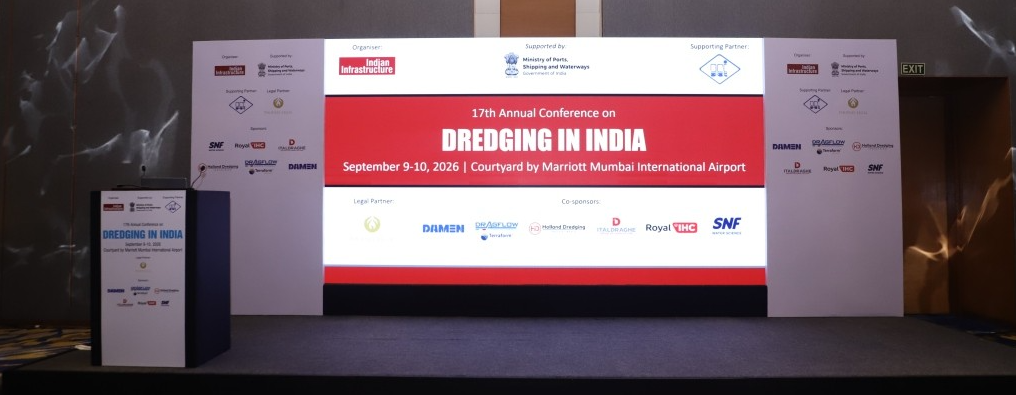
Twenty years ago, I was in India as a production engineer, supporting the start of dredging works for the Shell Hazira LNG terminal. After completing a production support visit, I treated myself to a few days exploring Mumbai.
This September, I returned in a different role.
I was there as a dredging consultant and speaker at Dredging in India 2026
organised by India Infrastructure. This time, I brought my wife along to experience this
remarkable city. It was fascinating to see how Mumbai has evolved over the past
20 years, while still retaining the energy and character I remembered.
Dredging in India 2026: A Rapidly Developing Industry
The conference provided an excellent overview of the dredging activity supporting India’s booming economy. Indian ports and waterways are progressing substantial capital and maintenance dredging programs, with further projects in the pipeline.
I particularly enjoyed the presentations on drilling and blasting of extremely strong rock and new terminal developments. The challenges of maintaining channels and rivers affected by India’s enormous sediment loads were also particularly interesting.
I was struck by how many port authorities attended the conference looking for ways to improve and innovate. Their willingness to share experiences, connect with others and explore new developments reflected a strong appetite for collaboration and learning from one another.
From Dispute to Insight
Our presentation, “From Dispute to Insight”, drew on the commercial modules of our Dredging and Reclamation Masterclass. It also incorporated lessons from our expert witness work.
One of the central lessons for preventing dredging disputes is deceptively simple. Define the dredge volume clearly.
Many dredging disputes do not arise from genuinely unforeseen physical conditions. Instead, they can begin with uncertainty about horizontal limits, the vertical datum, reference surfaces or the applicable drawing revision.
As an engineer, I find revision disputes especially frustrating. A complex and costly disagreement can sometimes come down to the parties working from different revisions. They can then become too entrenched in their positions to recognise and resolve the underlying issue. Meanwhile, the consequential costs and delays continue to grow.
Allocating Risk Where It Belongs
Another highlight was the legal presentation on risk allocation. Indian public contracts can seek to transfer extensive risk to contractors.
The principle proposed during the presentation was a fair one. Allocate each risk to the party best able to control it.
I would add another question to that assessment. Who receives the long-term benefit and should therefore carry the corresponding risk?
These are important considerations for dredging projects. Uncertainty around ground conditions, quantities, environmental requirements and operational constraints can have significant commercial consequences.
Looking Ahead
Thank you to India Infrastructure for an insightful conference and for the warm welcome back to India.
It was fascinating to return to Mumbai after 20 years and to see both how the city has changed. It was equally impressive to see the scale of development underway across India’s ports and waterways.
We hope i2D can contribute to some of the exciting port and dredging developments ahead.