Predicting Overflow Losses and Solids Retention with Confidence
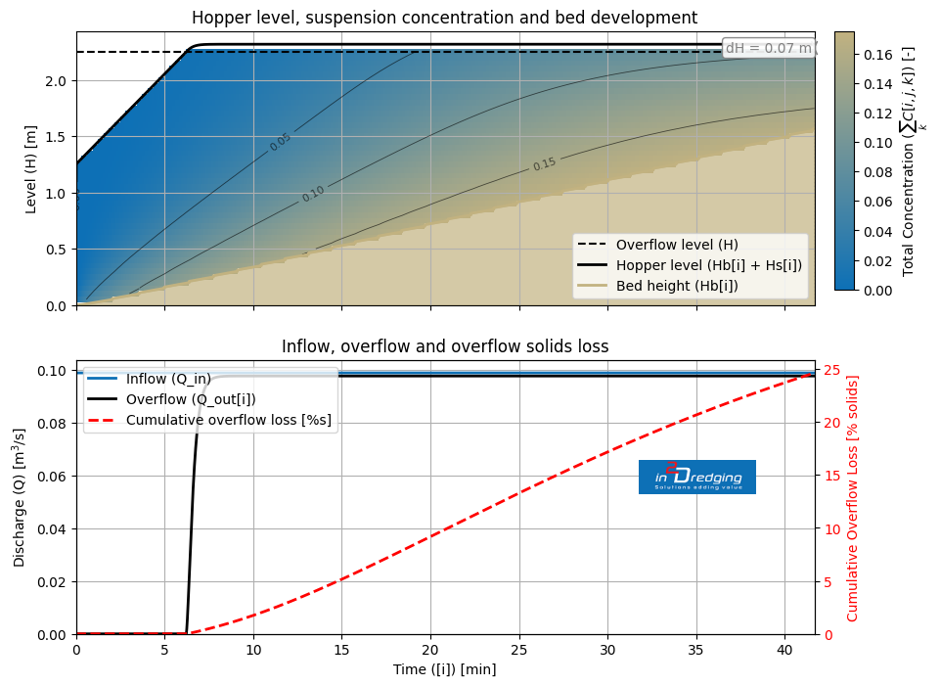
The Hopper Sedimentation Model (HSM) is i2D’s practical one-dimensional vertical (1DV) tool for estimating sediment retention and overflow losses during hopper loading operations. The model predicts how sediment settles inside a hopper or barge, how the sediment bed develops over time, and how much fine material may be discharged through the overflow. Typical applications include for example Trailing Suction Hopper Dredger (TSHD) loading, Cutter Suction Dredger (CSD) barge loading and other dredging operations where sedimentation and overflow losses influence production and environmental performance.
How the Hopper Sedimentation Model Works
The model discretises the hopper into vertical cells and calculates concentration profiles for multiple grain-size fractions throughout the loading cycle. Coarser particles settle rapidly and form a sediment bed, while finer material remains in suspension and may be lost through the overflow. HSM accounts for hindered settling, vertical mixing, bed growth, overflow discharge and optional bed shear erosion.
Key outputs include:
- Bed development;
- Suspension concentration profiles;
- Retained solids;
- Overflow losses;
- Retention efficiency; and
- Time-dependent sediment source terms.
Unlike
empirical approaches, HSM provides insight into the physical processes
occurring inside the hopper. Engineers can evaluate the influence of grain size
distribution, mixture density, loading rate, hopper geometry and overflow
strategy on overall performance. Typical simulations are completed within
seconds, allowing rapid evaluation of multiple operational scenarios.
Optimising TSHD and CSD Loading Operations
HSM’s typical applications include:
- Estimating CSD barge loading and TSHD hopper loading overflow losses and solids retention;
- Optimising hopper loading and overflow duration to optimise cycle production;
- Assessing “no overflow” versus limited-duration overflow strategies;
- Estimating source terms for sediment plume modelling;
- Comparing vessel, soil and operational scenarios;
- Evaluating TSHD and CSD loading system modifications; and
- Supporting vessel and hopper design optimisation.
The model enables engineers and operators to assess how vessel configuration, loading rate, sediment characteristics and overflow strategy influence payload, retention efficiency and overall production performance.
Supporting Smarter Overflow Management Strategies
For projects with strict overflow requirements, HSM can help move the discussion from a simple and often uneconomical “no overflow” rule to a quantified, risk-based strategy. In many cases, a limited overflow period can significantly increase payload while resulting in only marginal additional solids losses, and in some cases virtually no additional solids loss at all.
By quantifying this trade-off, HSM helps operators, designers, asset owners and regulators make informed decisions based on production efficiency, environmental performance and project objectives.
Validated Dredging Sedimentation Modelling
HSM has been validated against both laboratory and field measurements and provides a practical balance between physical representation and computational efficiency. As a result, it is suitable for tender estimates, production forecasting, environmental studies, concept design and operational decision-making.
Increased payload and reduced cycle times can also reduce fuel consumption and carbon emissions, contributing to more sustainable dredging operations. By providing a clear understanding of the relationship between overflow management, solids retention and productivity, HSM supports more efficient and environmentally responsible dredging projects.