Predicting
Fill Consolidation and Bulking Factors
Hydraulically placed materials often contain large volumes of water immediately after placement. As a results, they occupy a significantly greater volume than the original in situ material.
This increase in volume is commonly expressed by the bulking factor, defined as the ratio of placed fill volume to the original in situ soil volume. While coarse, free-draining materials often have bulking factors close to one, fine-grained cohesive soils and tailings can exhibit initial bulking factors of two to four, or even higher, immediately after placement.
The Fill Consolidation Model (FCM) is in2Dredging's (i2D) practical one-dimensional vertical (1DV) numerical model for predicting the consolidation behaviour of hydraulically placed materials, including saturated tailings, dredged sediments, and slurrified and segregated fines. By combining laboratory testing with numerical consolidation modelling, FCM provides a sound engineering basis for estimating fill densities, containment volumes, reclamation footprints and project costs.
How the Fill Consolidation Model Works
The Fill Consolidation Model (FCM) predicts how hydraulically placed fills consolidate under their own weight after placement. As excess pore water drains from the deposit, the material compresses, increasing its density while reducing its volume over time.
By simulating this consolidation process, FCM predicts bulking factors, density profiles and storage capacity requirements throughout the life of the fill. This is particularly important for fine-grained, fully slurrified materials, where uncertainty in bulking factors can have a major influence on project planning, containment design, reclamation footprints, storage requirements and overall project economics.
FCM combines laboratory-derived compressibility and permeability relationships with large-strain consolidation theory to simulate density development throughout the fill vertical profile. This provides a project-specific basis for estimating bulking factors, rather than relying solely on empirical assumptions.
FCM incorporates:
- Large-strain self-weight consolidation
- Stress-dependent compressibility obtained from Constant Stress Rate (CRS) testing;
- Void-ratio-dependent permeability;
- Drainage through the fill surface; and
- Density development through the fill profile over time.
FCM is particularly well suited to materials that undergo substantial consolidation after hydraulic placement, including:
- Fine-grained mine tailings;
- Dredged sediments;
- Slurrified and segregated in situ materials; and
- Fine fractions of reclaimed soils.
For these fine-grained materials, fill density and bulking factors cannot always be reliably predicted using empirical relationships alone. Laboratory testing combined with numerical modelling provides a more robust basis for engineering decisions during planning, design and operation.
CRS Testing and Numerical Consolidation Modelling
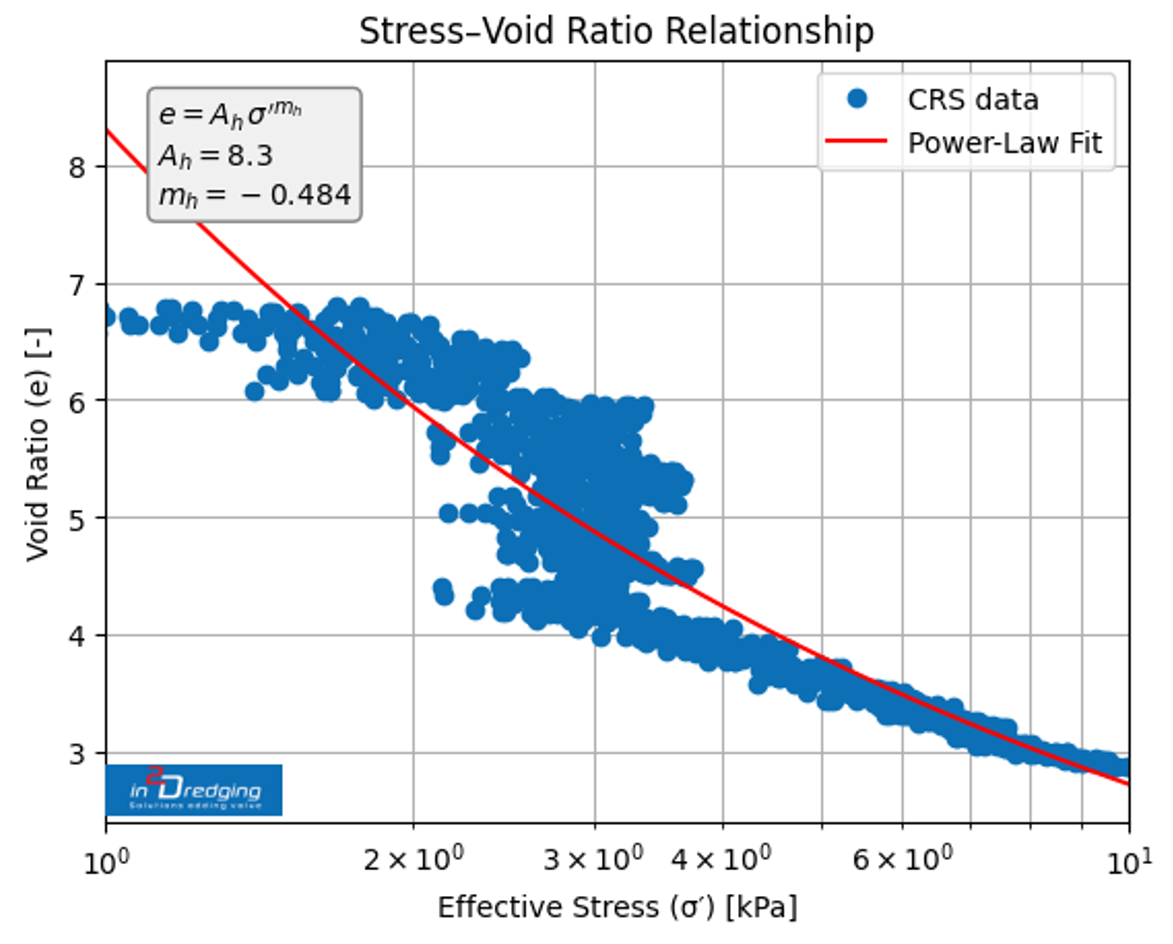
FCM can be refined using project-specific CRS testing results performed on reconstituted samples, ensuring the model reflects the measured behaviour of the placed material.
Where hydraulic placement results in particle segregation, laboratory testing can focus on the fine fraction that governs long-term consolidation behaviour. This material typically settles furthest from the discharge point before settling in low-energy deposition areas, such as sedimentation ponds, where the greatest volume changes are often observed.
The selection of the reconstituted test material can be informed by i2D's Return Water Quality (RWQ) tool, which predicts particle segregation during hydraulic placement and estimates the proportion of fine fraction that remains in suspension or is ultimately deposited in the sedimentation pond.
The resulting laboratory test data is then used to define the key material relationships within FCM. High-stress compression and permeability relationships are derived directly from laboratory data, while the low-stress slurry regime represents the behaviour of very loose material immediately after placement.
This establishes a direct link between laboratory-measured material behaviour and field-scale consolidation predictions.
Storage Capacity and Engineering Applications
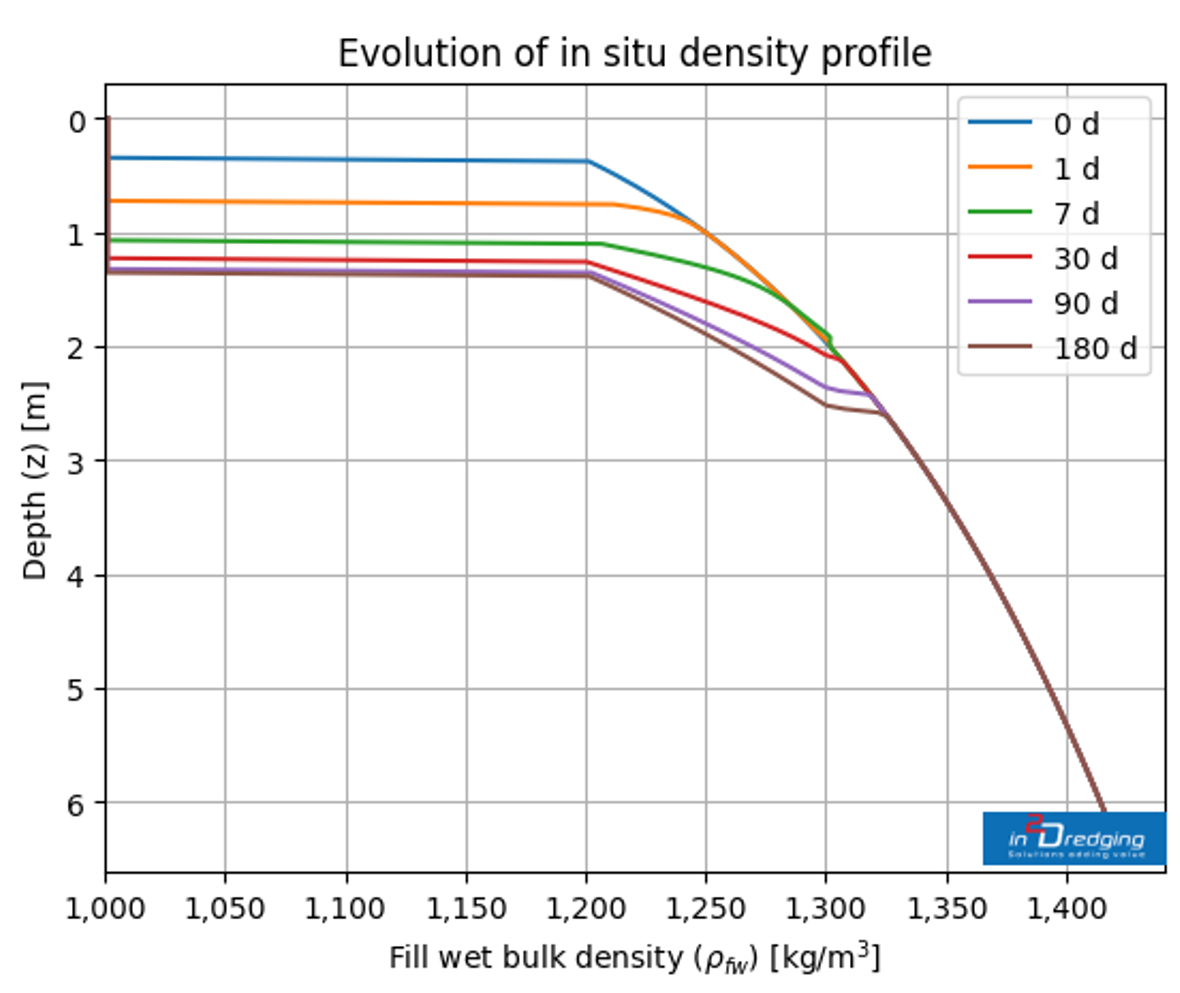
FCM predicts how the properties of hydraulic placed fills evolve over time, providing practical engineering information for planning, design and operation of hydraulic fill facilities.
Typical engineering outputs include:
- Wet bulk density profiles over time;
- Bulking factor evolution;
- Settlement predictions;
- Pore Water dissipation;
- Void ratio profiles; and
- Effective stress development.
These outputs support a wide range of engineering applications, including:
- Translating CRS testing results into realistic field-scale consolidation behaviour;
- Estimating density development in hydraulically placed fills;
- Estimating bulking factors for fine-grained and fully slurrified materials;
- Assessing the consolidation behaviour of tailings storage facilities (TSFs);
- Estimating storage capacity and storage capacity recovery in sedimentation basins;
- Assessing the influence of fill height on densification;
- Evaluating dredged material hydraulic placement areas;
- Estimating sedimentation pond areas, containment volumes and bund height requirements during project planning;
- Comparing alternative hydraulic filling and placement strategies; and
- Supporting feasibility studies, tender estimates and operational planning.
By enabling engineers to evaluate multiple scenarios quickly, FCM helps identify the parameters that most strongly influence fill performance. This helps project teams to make informed decisions during concept design, feasibility studies, tendering and operations, reducing uncertainty and the risk of redesign, project delays and contractual claims.

Fast, Transparent and Engineering Focused
FCM is designed for rapid engineering assessment, enabling engineers to evaluate hydraulic fill consolidation without the complexity of large finite-element models. Simulations are typically completed within seconds, making it easy to compare design scenarios, test assumptions, evaluate design alternatives and communicate results clearly.
The model provides a practical balance between physical realism and computational efficiency, while maintaining a direct link to laboratory test data.
This makes FCM well suited to feasibility studies, design support, operational assessments, project optimisation and expert technical reviews.